Pathways to Collaboration
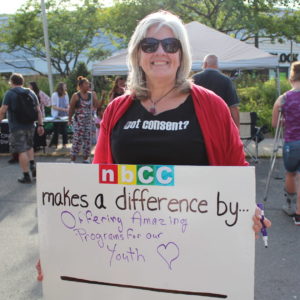
For the past seventeen years, the Northern Berkshire Community Coalition (NBCC) has been a vibrant community forum to address local issues. The NBCC was formed in response to the loss of 39% of local manufacturing jobs during the period of 1984-1986. In difficult economic times, housing, health care, transportation, and family stability are all at risk. Since its creation, the NBCC has been the catalyst for the creation of regional services addressing homelessness (Family Life Support Center, a homeless shelter and prevention programs), health care (Ecu-Health Care, a local physician led volunteer medical program for those lacking health insurance), transportation (TANB, a federally funded rural transportation network serving the Northern Berkshire region), and family stability (Parents Place, a facility to assist local parents; Safe Families Network, to assist families most at risk). These local programs are essential to maintaining the social safety net of the region, and have addressed issues brought to the NBCC by local residents and organizations. The presence of the NBCC in the Northern Berkshire region is critical to the community’s capacity to address local issues with local solutions.
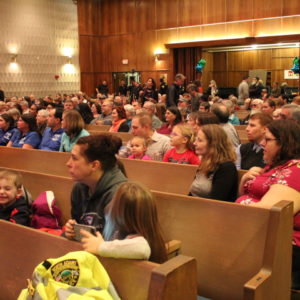
The NBCC has been successful in building local programs because of the community infrastructure it has created. As the keystone of our partnership, the NBCC hosts monthly forums that attract an average of sixty individuals representing both agencies that provide services as well as residents that receive services. These forums promote community dialogue and present a safe public space for the exploration of a variety of community issues. Information about local resources and issues is disseminated via a monthly newsletter and local access TV show. Our programs in youth development (UNITY) and neighborhoods (Northern Berkshire Neighbors) have built relationships that extend into special populations and helps to keep the NBCC a diverse organization. Our infrastructure has promoted community dialogue about issues that are important to the region. That is our strength as an organization.
All forums of the NBCC are open to the public and widely advertised. Each year in September, the forum’s agenda is a public hearing about community issues. Based on the content of that public hearing, the Coalition tailors its monthly meetings to address workable issues that have been presented during the September hearing. Service providers, consumers, and public officials, local faith based organizations, and others are involved in this discussion. Both the formal agenda items that are presented, and the opportunities for informal networking make the Coalition monthly meetings an important forum for the community. One cannot underestimate the importance of creating public space in a community. The style and predictability of these meetings has created a unique local public space for the Northern Berkshire community.
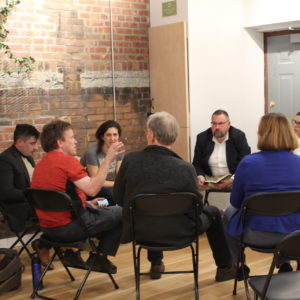
What is unique is the mixture of backgrounds of people at the meeting. Despite vast differences in community status, there are some commonalities that occur at our meetings. By sitting in a circle (and it can be difficult to craft a circle that may include over seventy people), everyone shares the status of gaining the facilitator’s eye. For the time that we share during the Coalition monthly meeting circles, we are equals. We share a common hope for a better community. Respect and trust for each other are basic tenets that underwrite each meeting’s process. People know what to expect at each meeting, as the format has been the same for more than ten years. What is truly inspiring is that people keep coming, and perhaps that is the greatest measure of success of these gatherings.
Our involvement with local neighborhoods, youth, and service providers makes it easy for us to go to the experts when we are addressing social issues. Our definition of expert includes both those that have working or academic experience and those that are living the issue. We have come to expect an interchange from everyone on specific community issues. Located in northwestern Massachusetts, the NBCC has the good fortune to work with faculty and staff of two prestigious higher educational facilities; the Massachusetts College of Liberal Arts and Williams College. Their staff and faculty have added a respected academic component to the service providers who often lead the community in identifying social issues. Residents help us to keep the process honest, and their inclusion is necessary for our success.
As an example of a successful community intervention, we have looked at economic standards for family economic self sufficiency since their release by the Women’s Exchange and Industrial Union (WEIU) five years ago. With help from the academics in our community, we were able to discern that about 30 % of North County households do not meet these standards, and are thus by necessity dependent on outside supports to live in the region. Our conversations with local residents and service providers helped us to understand what is necessary for family economic self sufficiency: capacity to read or use technology; adequate child care; a local transportation system that promotes access to employment or training for those without cars; and access to health care. We have spent time during recent years, exploring each one of these root issues affecting family economic self-sufficiency, devoting monthly meetings to each topic. We promoted an extensive application to increase local literacy efforts and helped competing applicants come to an agreement to work together. We promoted the need for greater childcare services. We hosted the Director of the Executive Office of Health and Human Services who talked about health care access, and we had broad discussions about transportation and the need to improve our local public transportation system. In addressing root barriers to economic self-sufficiency, transportation is the area where we had the greatest success. Our work in transportation points to the painstaking process necessary for success in our collaboration.
A number of meetings that brought together residents, academics and service providers helped to provide the background for our annual visit with Congressman John Olver, who is the ranking Democratic member of the Transportation and Treasury Subcommittee for the House Appropriations Committee. Congressman Olver was impressed with anecdotal information (through stories by community residents) that we provided about our transportation system, and suggested that we link with a national transportation organization (Community Transportation Association of America) and work with our regional planning authority to create an inventory of local transportation assets and needs. After doing this, a meeting with Congressman Olver and his staff led to federal funding for a rural job-linked transportation network. Since its start up in September 2002 over 30,000 employment-related rides have been brokered by our new transportation network. The creation and support for this network, which Congressman Olver describes as “coming from the people” is a measure of our success as a collaboration.
Our mission is “to organize people and resources dedicated to improving the quality of life in Northern Berkshire.” Our mission at times is daunting, but also allows us the flexibility to address many different issues concurrently. As a neutral organization, we are able to take on local issues as planners and then look others who will implement programming. Organizations that have a single-issue mission (health care, mental health care, day care, etc) are limited by their mission in the work they can undertake. The NBCC by nature of its broad mission and participation does not have those limitations.
I believe that the greatest challenge we face in bringing together people most affected by local issues is addressing the sense of hopelessness and isolation that many experience. Many of our issues seem too big to tackle. People are affected by activities that the local community cannot control, adding to the sense of hopelessness. Many residents give up and say, what’s the use? They have little way of becoming involved in the process of local decision-making.
Timing and opportunity afforded the NBCC the resources to reconsider our community role and bring new partners to our work. In the early 1990’s, as a community participant in the WK Kellogg Foundation’s Community Based Public Health (CBPH) Initiative, the NBCC was able to secure necessary resources to address how we better engage the community in managing its future. We created separate forums for neighborhood residents (Neighborhood Meetings) and youth (UNITY Forums) that meet at a time residents are available and serve nutritious and inviting food. An enhanced role for local residents has been the greatest change in the NBCC over the past ten years, and has been an outcome of our involvement in CBPH. Our name change as an organization from the Northern Berkshire Health and Human Services Coalition to the Northern Berkshire Community Coalition (1994) is reflective of our changes. As a community coalition, we bring fun and hope to our process, and engage local residents on a new level. There is a sense of informality to our work, and while some of our discussions have been rightfully painful (meeting following 9/11), that has been the exception and not the rule.
Secondary to the sense of hopelessness and isolation that people experience are the difficulties that citizens and organizations have in working with long established institutions (churches, schools, health care facilities) as equal partners. Prior to our involvement with CBPH, our coalition was seen as another health and human services group. Our name change to that of a Community Coalition helps set us apart from the more traditional institutions and allows us to be a distinct voice with residents in local partnerships. Yet, engaging residents as valued community members is an ongoing challenge for our traditional institutions. Our work continues.
As a community partnership, the Northern Berkshire Community Coalition is highly successful as measured by community participation and results of our advocacy. Why we are successful must extend beyond the personalities of the staff working for the Coalition. We need to determine what works, so we can continue our success beyond the terms of its leadership. We do not want to rest on our laurels, rather want to do our job better. The opportunity to participate in this process will allow us as an organization to become more reflective and intentional in doing what works well. That is our hope and interest as we apply to become a participant in Pathways to Collaboration.